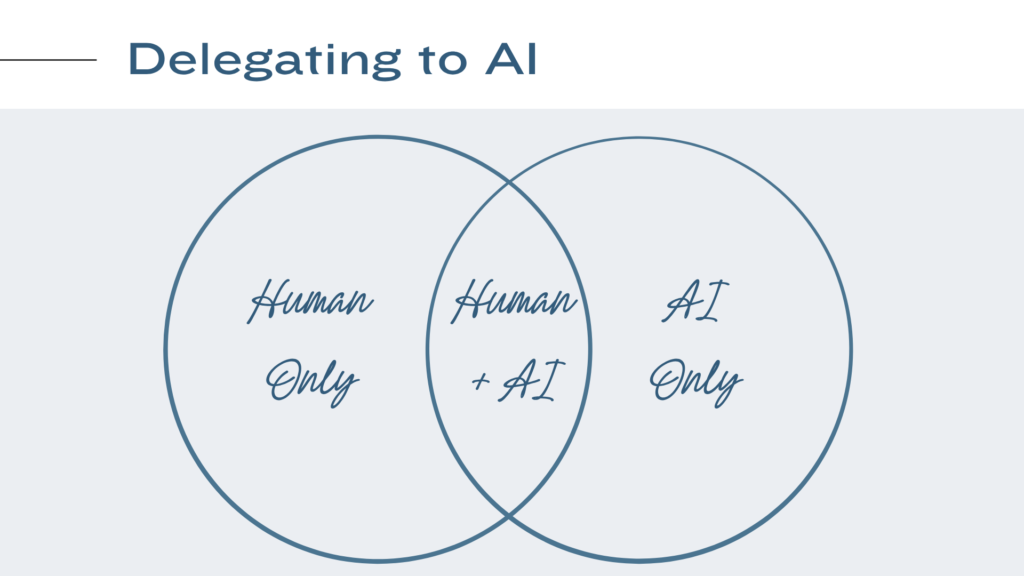
Two overlapping circles on a piece of paper. Human only on the left, AI only on the right, and the overlap in the middle where almost nobody is spending any time at all.
That is the whole exercise. My cousin Kendall gave me the version of it that ended months of AI pushback inside her tech company, and I tell that story at the top of the episode. What matters here is what it does.
This is episode three of Human First: AI for High-Trust Businesses (you can catch up with episode 1: Human First AI Is a Decision Not a Vibe and episode 2: Where AI is Quietly Breaking Trust in Your Small Business). The first two made the case for deciding on purpose instead of by default. This one is the deciding, one workflow at a time, until you can say out loud what stays Human First and what you delegate to AI.
Most of us sorted this badly on the first pass. We asked for the sales strategy, the next offer, the campaign copy, got back something generic that could have been written for anybody, and concluded AI does not work for a business like this one. But a smart CEO doesn’t start delegating the most strategic level work first – they start with the easiest work to train.
This episode and exercise is all about the practical steps required to intentionally integrate AI into your business systems.
What You’ll Learn in This Episode
- Why almost nobody hires a strategist as their first team member, and what that says about where you started with AI
- The three columns and one afternoon that ended months of AI pushback inside a tech company
- What stays on the human-only side of the Venn diagram permanently, no matter how good the tools get
- The overlap almost nobody is working in, and what skipping it actually costs you
- How the CEO Scorecard already told you what to hand off first, years before any of this showed up
- The message from my first virtual assistant that named the real problem, and it was not her
- What I am hiring for now that the tasks I used to hire for are handled
Key Concepts from the Episode
You Cannot Delegate Confusion. Handing something off does not make it clearer. Whatever is fuzzy in your head arrives fuzzy in the output, and it does not matter whether that output came from a person or a tool. Chaos does not get organized on its way out of your brain.
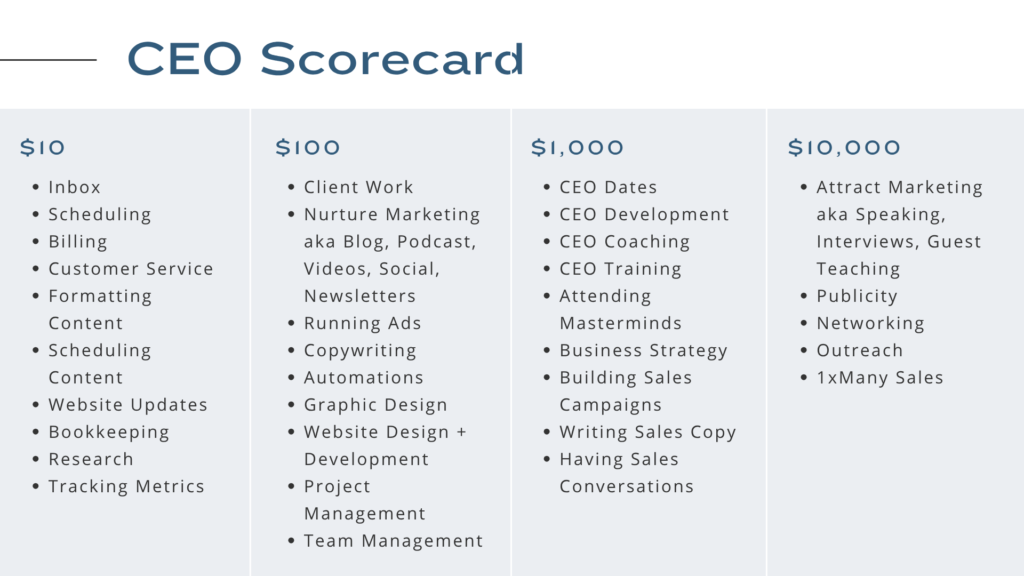
Start at the Bottom of the CEO Scorecard. The CEO Scorecard sorts your hours into $10, $100, $1,000, and $10,000 buckets. The $10 work is where AI belongs first, for the same reason it is where your first hire belonged. If you would not have handed it to a brand new assistant on day one, do not hand it to AI on day one.
The Overlap Is the Whole Job. Human only on one side. AI running unattended on the other. The middle is training, feedback, and correction, and nothing arrives on the right side without passing through it. Nothing starts in the automated column. Everything gets promoted into it.
Redefine Your Role as CEO or Stay in the Way. Every time you move work off your plate without rewriting what you own, you get pulled back in. My list narrowed down to three things: content, community, communication.
Somebody Absorbs the Efficiency. When AI collapses the hours a role used to take, the default move is to shrink the role. The other move is to hand that person harder work, more autonomy, and more pay. The hours you save have to land somewhere. Deciding where they land is a CEO decision, not an accident.
Resources Mentioned
The CEO Scorecard episode. The full breakdown of the four value buckets and how to calculate your goal CEO score.
The 90 Day CEO Planner. The CEO Scorecard is an essential tool built into our planning system.
Our AI statement. Where we stand on how AI gets used inside this business, and what we will not do with it.
Descript. The tool that now handles podcast transcription and editing in one place.
Want to Learn AI From the Same Program I Did?
Callan Faulkner’s AI Employee Bootcamp is where I built the AI infrastructure now running behind my marketing, my client delivery, my finance reporting, and the tech stack that holds it all together. I came in with the systems and SOPs I had already built through my 90 Day CEO Operating System®, and we built the automation layer on top of them. I am going through it again because there is still more I want to implement.
Register through my affiliate link and you get a bonus bootcamp debrief group call with me, to translate what Callan teaches into a high-trust, relationship-based business. That translation is the part most AI training skips entirely.
Register for the bootcamp through my affiliate link.
I earn a commission when you register through that link. I was sending people to Callan long before there was a commission attached, and I am currently a student in her program.
About a year ago, my cousin, sisters, and I rented a house in downtown Staunton, Virginia, so that we could attend the Queen City Magic and Mischief Festival. This is a full Harry Potter themed weekend where the entire downtown basically turns into Hogwarts. It was so much fun. And it's not what I want to talk about, but that's where the conversation happened.
I was hanging out with my cousin, Kendall, catching up as we do anytime we get together, and asking her how her job was going. She works for a tech company, and I knew there had been a lot of big changes. I was really curious because I know a lot about how she operates. I was curious how AI was impacting her role and her company as a whole.
And she told me that her company had mandated the goal that everybody use AI about 70% of the time in their jobs. And as you can imagine, there was pushback. People weren't all bought in. Some people had different objections, thinking that this is just coming ahead of layoffs. It's beneath me because I'm a tech genius. Some people were already using it, and now we're just admitting it out loud.
There was a lot of mixed feelings throughout the entire business around AI and the adoption of it. But Kendall explained what ended all of the pushback, and it wasn't some big town hall or memo or leadership making a better case for why they need to adopt AI. It was a sorting exercise that just took one afternoon. Three columns on a piece of paper.
And here's what I have not been able to stop thinking about since. When she described it to me, I recognized this exercise immediately, because this is the exact same exercise that I have been walking women entrepreneurs through for decades. It has nothing really to do with AI. It has everything to do with delegation, and the only thing that has changed is who you are delegating to.
So today I'm going to walk through this exercise with you so that you can get clarity around what you are delegating to AI exclusively, what you are delegating to AI plus a human, and what you are delegating to the humans that work with you. Let's get into it.
Why I Am Making This Series
Hey there, CEO. Racheal Cook here, founder of The CEO Collective® and host of the Promote Yourself to CEO® podcast. I have really been enjoying putting together this series for you, Human First: AI for High-Trust Businesses. I think this conversation is so important, and it's one of those things where I see mistakes happening all the time in small business, and it's easy to believe these mistakes are unique to AI.
But truly, the more I dig into it, the more I'm realizing the mistakes people are making with AI are the same mistakes people have been making in small business for a really, really long time. I see people making mistakes where they aren't actually pressing pause to make thoughtful decisions as the leader of their business.
If you are the CEO of your business, you are the keeper of the vision and the values. You are the one that your entire business culture comes from. And if you're making decisions, whether it's about AI or about hiring or any big move in your business, and you're not running it through your vision and your values, then you're making decisions by default, just one convenient shortcut at a time.
That is leading a lot of people to take action without actually sifting through what the impact or the outcome is going to be. And that's why I think this conversation is so important, because like I mentioned in the last episode, we're seeing a lot of people who've jumped on the AI bandwagon who didn't press pause to really run this decision through their vision and values filter, and they're breaking trust without intending to.
If you're anything like me, the relationships that have built your business, your community, your colleagues, your clients, your team, this is the cornerstone of everything for me. And I have learned that if I'm not putting them at the forefront, if I'm not putting all of these relationships at the forefront and really protecting those relationships, protecting the trust that I have spent decades building, it doesn't take much to break it. It really doesn't.
So in this episode and the following episode, I want to get really practical with you and help you decide on purpose. I want to help you get really intentional about how you can use AI in a way that feels like it is in integrity for you as a small business owner, especially a values-based small business owner.
The CEO Scorecard and the Value of Your Time
Now, like I mentioned at the top of this episode, there's an exercise my cousin mentioned that I instantly recognized as a delegation exercise. But before I get into how to do that, I want to share with you how I've been talking about this for a long time.
We have a tool inside of The CEO Collective® called the CEO Scorecard. This is a tool that I have adapted from my background in consulting, and in fact, it has become a fully integrated part of how we support small business owners. If you ever have purchased our CEO Planner, you have seen the CEO Scorecard right there in front. It's built into how you're tracking what it is that you're doing throughout the course of your week.
I have a full episode on this, so I'm not going to go too deep into the CEO Scorecard, but basically what it does is it takes time tracking and then adds another layer onto it. A lot of times if you work with a coach, at some point they'll ask you to track your time, and they're asking you to track your time so that you can bring awareness to where and how you're spending your time. It's a great exercise. Highly recommend doing time tracking at least once a quarter just to see what is happening and where your time is going.
But I like to add this additional layer of the CEO Scorecard, where once you track your time, you're also assigning a value to each hour of your time, and the value you're assigning is based on the types of tasks you have been focused on. On the CEO Scorecard, we have this broken up into four categories: $10 an hour, $100 an hour, $1,000 an hour, and $10,000 an hour.
Quick note for anyone who is already asking. This is an exercise about clarity for you as a small business owner. This has nothing to do with accounting or money actually flowing in and out of your business. This is basically a way for you to quickly assess whether or not you are focused, your time, your attention, and your energy on CEO level work, on work that is growth oriented, or if you're focused on more maintenance level work that doesn't move your business forward. It's what your business needs to operate to maintain its current status, but not growth oriented.
The Four Buckets From Ten Dollars to Ten Thousand
So as you're using the CEO Scorecard, you're tracking your time, and then you're going through and deciding for every hour of your time, what is that hour worth to you?
If you're doing $10 an hour tasks, these are going to be the types of tasks that are very repetitive, that are very yes or no oriented. There's no additional level of skill really needed once you understand how to do the task. So I would say these are going to be a lot of really basic administrative tasks, ops tasks, maybe some basic customer service tasks. Things that are pretty easy to train someone on, that you can have very clear SOPs for. Here's how you run this report. Here's how you input this data. Here's how we categorize the bookkeeping. Here's how we update the website. These are very repetitive tasks.
Then we move a little bit higher up to $100 an hour. Everything in this bucket is a little bit more skilled, meaning you do have to bring some of your own experience and expertise to the table in order to do this well. So this is where design comes in. This is where copywriting comes in. This is where content creation and creative for ads comes in. All of that requires a level of skill. I would also say this is where people management comes in, so project management and things along those lines.
You do have to be skilled here. You have to know what done looks like. You have to know what the end result is supposed to be, and you're going to have to bring to the table your skills, your background, your knowledge, your point of view into that piece. So this takes a little bit more time to train. It takes a lot more communication to get on the same page. But still, a lot of this is not directly revenue generating. It supports the business, it maintains the business, but it's not as closely tied to generating more revenue and growing the business.
Then we get into the next two categories, which is $1,000 an hour and $10,000 an hour. This is what I identify as CEO level work. Once you get into these categories, this is the higher level, more directly connected to revenue generation work that truly only you are going to be able to do, or much more skilled team members are going to be able to do. This includes things like strategic planning, business development, product development. This includes sales, especially if you are doing sales one-to-one. This is going to be the work that is a lot closer to how you generate revenue in the business.
And the final category is the $10,000 an hour. This is going to be the type of work where you are doing the revenue generating work at scale, meaning you're not just having a sales conversation with one person, you're hosting a sales event, maybe a webinar or a conference where you're selling from the stage in front of a lot of people at once. This is where you're getting into really high visibility that fills your pipeline with potential clients. So this is the highest level revenue generating work that you do in your business.
Where Most People Get AI Wrong
When I teach this, and I'm going to link up the entire episode about the CEO Scorecard if you want to learn more, you don't have to buy a planner in order to adopt this. You can learn about it and try it out yourself, no purchase necessary.
But the reason I bring this up is when I teach this, it's not just an awareness exercise. It also is an exercise to help my clients see where they need to fire themselves, where they need to hire someone so that they can move further into more of their time being spent on the higher value work in their business, the growth-oriented work in their business.
The scorecard already tells you where to focus first. The $10 an hour tasks, the $100 an hour tasks next. You start at the simplest tasks to get off your plate, the things that are the easiest to train, the things that are the most repetitive, and then you move up from there and you train up from there.
Where I see people getting AI wrong is that so many people are trying to apply AI out the gate at a higher level. They're trying to get AI to do the growth-oriented work for them. That's work like write my sales strategy, come up with my content, come up with my next offer, come up with the copywriting for this new sales campaign. And then they're disappointed, and they conclude that AI isn't going to work for them.
This is kind of interesting to me as I'm watching this pattern play out, because most small business owners don't go out and hire their first team member to take over strategy. The first team member they hire is for the administrative tasks. The first team member they hire is the bookkeeper. The first team member they hire is someone who's going to answer the emails and organize your schedule. But for some reason, I'm seeing a lot of people jump into, well, AI is going to now become the marketing department for my business or the sales department for my business, and there's no foundation in place.
The Human and AI Venn Diagram
The important thing to remember about building a team and delegating tasks is that as you get into the more complex, the more nuanced tasks that you are handing over, there's a lot more training that needs to happen. There's a lot more context people need in order to do a good job, and this is the missing piece, I think, when it comes to the adoption of AI. You still have to put the foundation in place.
And that brings us to the exercise that my cousin shared with me that I instantly recognized as a delegation exercise. Now, I want you to imagine, and maybe even draw out for yourself, a Venn diagram. We all know what a Venn diagram is, right? Two overlapping circles.
On one side, on the left-hand side, is human. Human only. On the right-hand side of the Venn diagram is AI only, and the overlap there is human plus AI. Another version of this, by the way, could be a Venn diagram with CEO on the left replacing human, team on the right replacing AI, and the overlap being CEO plus team.
And what this Venn diagram represents is how you go through the process of determining what gets handed off.
What Stays Uniquely Human
So in the context of humans and AI, the left side of the Venn diagram, we need to think about what are the things that are exclusively human domain. In your business, humans are going to be the ones to be responsible for this, to drive the outcome for this.
So in my Venn diagram for my business, one big piece of that is anything that requires my point of view, my judgment, my experience, my expertise, my relationships, my stories, my thoughts about something, my opinions. That is uniquely human. AI is not going to be able to replicate any of those things.
The next piece that I think is really important here is the strategy. Again, this could be human. This could be CEO specific. As you build your team, you can have your team do this exercise. But in my business, I maintain responsibility for the vision of the business and the values of the business, which then informs the strategy.
So even as I have a team member do this exercise, they might be responsible for a portion of this strategy. I hand off ads to Gabi, and she's responsible for the ads strategy, for how we're getting in front of more people and growing our audience. But I'm responsible for the bigger strategy that that feeds into. So humans are responsible for big picture strategy.
Humans are responsible for developing the intellectual property. So the actual intellectual property that runs our business, the intellectual property that we teach our clients, all of the frameworks, all of the systems, all of the strategies, all of that is uniquely human.
And the next piece is relationship driven. This is going to be community, this is going to be clients, this is going to be colleagues, communication with all of the above. Any time we're actually interacting with, communicating with people, other humans, there's going to be a human on both sides of that equation. So this is one of the most important things, is to identify what is uniquely human when it comes to any of the tasks that you are looking at.
What AI Can Run Without You
Then we get to the right side of this Venn diagram. That right side is AI without a human. AI without a human.
Now, the first things that I can very easily hand off to AI without a human are going to be the $10 an hour tasks. They're going to be the repetitive, the super defined, the very easy to teach and train, the low judgment, meaning you don't have to have a point of view or an opinion. This is pulling metrics into a dashboard, keeping the financial numbers updated. This is transcribing the podcast episodes. This is the trigger-based automations. This is any data work or any research work. So these are things that can run unattended in my business once AI knows how to do it and do it well, to the level that I want it done.
And here's the important piece. Nothing just starts in this bucket. You have to teach and train AI how to do those things to the level that you want them done, and that's really important.
What's sitting in this side of the Venn diagram of AI only in my business is there right now because it's straightforward, and it doesn't need to have a whole lot of input from me. Things that are taking longer are the things that need time to be trained, need time to be refined, and this is the missing piece of the puzzle for a lot of people when it comes to using AI.
The Overlap Where the Real Work Lives
Again, you can replace human on the left and AI on the right with CEO on the left and team on the right, and the overlap of this Venn diagram in the middle is where the real work lives, and almost no one is spending time or attention here.
This is the training. This is the collaboration. This is the upskilling. This is where you are actually getting that team member to fully understand what the output needs to look like to your standards, to your specification. And then once they really, really have it, then you fully delegate that out to your team member.
Well, the same thing is true for a lot of AI. A lot of what you're hearing right now about building AI employees or AI agents, it's got to run through this bucket first of collaboration to sharpen the skill set. So you want to keep that in mind. A lot of the tasks in here are actually things that are being trained, things that are being upskilled, and once AI has it dialed in, then it can run most of it with very little interference from you or your team.
A great example of this is going to be the way that we do our podcast. Our podcast is a system. We've had this done for years and years and years. I've had a podcast producer for years, and then my husband took that over several years ago, so we had a very, very detailed SOP for what happens at each stage of the podcast.
If I had this Venn diagram and I'm outlining all the tasks for the podcast, the things that remain on my side of the Venn diagram are going to be things like coming up with the ideas for the podcast, outlining the podcast, actually sitting down and recording the podcast. Those are things that only I can do. No one else is going to touch those. That's what I'm responsible for.
Then I start passing it off. And the pass off means I've got to train someone until they know how to do it exactly the way that I want it, and then they can take full ownership over every part of delivering the podcast. So in that training, it looked like teaching exactly how I wanted the show notes done, exactly how we edit the podcast. Where does the intro go? How does the music go? Any of those types of preferences. How do we put together the show notes and the social media post and the newsletter? All of that had to be trained, and then once it's trained, they know exactly how to do it, and it's 100% their responsibility. So now that whole workflow can easily be divided.
Why You Cannot Delegate Confusion
One of the biggest mistakes I see small business owners make is they hope that just by delegating something or outsourcing something, all of their problems will be solved and they'll get that thing off of their plate. And what they neglect is taking the time to truly build strong onboarding and training for their teams, and understanding that that process of onboarding and training takes real hours.
People who do this well understand this. They know that you have to have an onboarding process where you're giving your new team members all of the context they need about your business. They need to understand the vision and the values and how you make decisions. They need to understand the current strategy and how their work fits into that. They need to understand who is your client and what are your offers and how do you do the things that you do. All of that is context they need in order to do their job well.
And then they need actual real on-the-job training. You can throw an SOP at somebody, but there needs to be some rounds of feedback to make sure that they truly understand what the end result needs to look like according to your specific standards and requirements.
So when we skip all of that, when we just throw someone in a role, cross our fingers and say good luck, we aren't setting them up for success. And then we run into more problems. We run into, well, should I just let this person go? Or maybe you don't really know how to train and give feedback, and so you find yourself constantly saying, well, it's just faster for me to do it myself. It's just easier if I take it back. You end up redoing work. All of these become massive problems within a business.
So it's essential that you understand you can't delegate confusion. You can't delegate chaos. That was always true with hiring a team. And it's still going to be true here with AI. You have to slow down before you can speed up. You have to take the time to really train AI to understand what you want the outcome to look like and define it before it will do it to the standard that you actually want.
So I want you to choose an area of your business that you are already maybe dabbling with AI in, and run that workflow through this exercise, through this Venn diagram. I just gave the podcast example. Maybe for you, it's your newsletter or your social media. I know from so many conversations with this community that marketing is one of the biggest bottlenecks that we have, and I truly feel like it's one of the biggest opportunities for AI to support small business owners.
But I want you to be crystal clear about what parts of that marketing workflow are uniquely yours, the human-only parts. What do you want the AI to ultimately be able to do? And then identify what you need to do in that AI plus human, the intersection between both circles in that Venn diagram. What is it that you need to train your AI on in order to get the result that you truly want?
This is going to be a game changer for every single business. Now, when I sit down and do this exercise, I do it quite often. Whenever I'm going through, especially because I'm still building out a lot of my AI infrastructure, I'm still going through and training a lot of our workflows in our AI. I'm constantly going back and doing this exercise for each new workflow.
I find it's helpful to pull out a new Venn diagram for each new workflow. So I'm doing it for the podcast, and then I have one for social media, and then I have one for other projects going on. And I've found there's a lot of similarities that I often can just transfer across the board, and it helps me really see where humans' role is solidified in my business.
Redefining Your Role as CEO
This actually reminds me of another exercise I did years ago, which was redefining my role as the CEO of this business. And I give this exercise to my clients all the time, because one of the challenges that I also see as you start to delegate, whether again it's to someone on your team or to AI, is as you move things off your plate, it's really easy to have these new team members or these AI assistants, if you will, and not really reevaluate your own role. And that can become a major issue.
If you don't redefine your role as CEO and get clear about where you add the most value to your business, you can find yourself getting sucked into other things.
So I realized every time I was hiring a new team member, I was writing a super detailed job description for them, I was getting them onboarded, I was getting them trained up, but I was missing something, and I kept getting in the way. And I kept getting in the way because I hadn't redefined my role as CEO.
For example, when I hired my first ever virtual assistant, I hired an amazing virtual assistant. She was fantastic. But because I never redefined my role, I was kind of a helicopter CEO. I kept checking in on the inbox. I kept responding to people before she could even respond for me. And finally, I got a message from her saying, Rach, get out of the inbox. This is what you hired me to do. I've got it.
And she was right. I loved that she called me out on that. Nothing was wrong with her, and she definitely was showing me what a great job I did hiring her, because she was willing to say, hey, this is why I'm here. Let me support you. What I was doing wrong was that I hadn't redefined my role, so the lines continued to be blurry, and I continued to get in the way.
And that's what I find a lot of people are doing, not only as they hire their team, but as they are delegating things to AI. They sort their tasks. They start training AI to take things off their plate, but they don't have clarity on what are the most important things that only they can do, that is what they need to maintain control over as the CEO.
Content Community and Communication
For me, my role as CEO really comes down to three things.
First, content. Content because it requires my point of view. Content because it requires my opinion and my take. Content because it requires my intellectual property. That's one of the things that I'm not going to hand off to anybody, not a team member, not AI. All of the ideas are still coming from me.
Community, because I don't want to outsource relationships. Every time I spend real time with my people, my community, my colleagues, my clients, business gets better. More opportunities show up. Things pop up that we never could have imagined. So the more time I spend with people, the better everything gets. I will never step away from that.
And finally, for me, is going to be communication. Communication in and out of the business. I've really gotten clear on that, because while I have worked with copywriters in the past, I have seen over and over again the power of people not only being able to read my newsletter or read my content, but when people can see and hear you, it adds a whole other layer to it. When they can hear the way that you sound when you talk, the inflection your voice makes, the pacing when you're telling stories, there's something so much deeper that connects you on this much more personal level.
So those are the things that, as I do these exercises again and again for different things I'm trying to build with AI, it just continues to be reinforced to me. The most important parts of my role as CEO, and that gives me permission to hand more things out to my team or to AI.
What AI Is Already Replacing
We're going to wrap here in a second, and I just want to zoom out, because what's happening in the broader economy is happening for small business too, just on a different scale.
AI still is going to replace entry-level work. We're already seeing that. We're already seeing that. I have been seeing this for years. The repetitive, the lower level, highly repeatable tasks that don't require any high skill set. They don't require a lot of judgment. They're very clear-cut. Those are always the first things that are going to go.
I remember years ago when I started the podcast, I actually used to have to pay a dollar a minute for transcripts, because we didn't have AI that could create transcripts for us. You used to have to pay an actual transcriptionist a dollar a minute. That meant every time I had a new episode going out, if there was a transcript going alongside of it, that could have cost me anywhere from $30 to $60 per episode just for the raw transcript to be hand-transcribed.
AI has already replaced that, and now it's built into a tool. It's built into Descript, and I pay less for Descript every month than I used to pay for one podcast episode to be transcribed, and Descript does the whole editing process for me. It's wild.
So this is not a prediction. This is already happening. This is the same pattern as when automation started showing up in factories. Think about how automation showed up in factories, where now there are robots that can build cars or robots that can build products. This is the way that, honestly, progress continues to happen. Automation was already there. AI is just automation at scale, and that's what's going to happen.
Changing the Shape of Your Company
Here's where I think a lot of small business owners are getting it wrong, though. I think that this is an opportunity to really reevaluate what your future business is going to look like and the future shape of your organization.
I think a lot of people are letting go of the lower level work, and they just let people go. And these could be really skilled people, really smart people, who have a lot more to offer. I think this is the next level opportunity for a lot of us as we are thinking through this, and I'm thinking through this too, is thinking about how the roles are going to change in my business moving forward. How am I going to move people up in their role? How am I going to help them upskill? How am I going to train them up?
For example, my husband has been helping me behind the scenes with my podcast for years now. So now that we have collapsed the amount of time it takes to do that job, he's not necessarily going to work less in the business. Now I look at it as he's freed up to take on other projects, other tasks that I still need to move off my plate. I can give him more to work on.
This also gives an opportunity to move people up to roles that allow them to have more creativity, more autonomy, more responsibility, and that also should look like more pay. This is what I see that recirculation looking like on the team level.
And I really think this is not just a nice gesture. This is a smart business decision, because when you take care of your people, they take care of you. That was my thesis for the very beginning of this whole series. When you take care of people, they take care of you, and I find people want to learn. People want to be valuable. They want to continue to contribute. And if you give them ways they can do the work better and faster and free them up to do something else, that is an opportunity for both of you.
Especially if you already have people who are culturally an amazing fit, who values-wise are an amazing fit. They already know your business inside and out. They already have relationships within your business, within your team, within your community and your clientele. Now you can have people grow with you as you're able to ride this wave of AI. I think this is such an incredible thing that we can all lean into even more.
The way I hire from here is going to change. I know that. Because this is such a new technology, and the way I'm applying it is probably a little unique and different than a lot of other small businesses, I know that I'm still going to hire primarily for the things that I can't teach. I'm going to hire for creativity. I'm going to hire for strategic thinking. I'm going to hire for collaboration skills. I'm going to hire for values alignment. I'm going to hire for people who are on board with our vision. I'm going to hire for people who are thinking out of the box, and I'm going to train them for how AI can be the system behind the scenes that makes it easier for us to do what it is that we do in this business. My next hires are all going to be the people who bring their own genius.
So if your business is about to get more productive, I want you to start thinking about how does that change the shape of your business in the coming years? This is CEO-level strategic thinking, and I want to be ahead of that. I don't want to fall into things happening by default because I didn't press pause long enough to say, oh, here's how it's going to change the shape of my company.
Your Homework for This Week
And changing the shape of your company, changing the future of what it looks like, starts with this simple exercise that I gave you today. So here's your homework, and I mean it. This is homework, y'all.
Pick one area of your business this week. One function. I recommend marketing, because in my experience talking with so many people, this becomes the bottleneck where a lot of people are stuck, where a lot of people drop the ball and find themselves in the feast or famine cycle.
So I want you to drill this down a little bit more. Not all of your marketing, because there's probably a lot of moving parts there, but think about the core part of your marketing. The one thing that is your core marketing system, the one that drives the most results for your business. For me, it's everything tied into my podcast. For a lot of us, it's going to be our signature long-form content, but it could be something else. Doesn't hurt my feelings if you pick something else, y'all. Just pick something that is taking a significant amount of your time, that you know you need to stay consistent with, and that you know AI could support you with.
So the first part of the process is to actually document yourself going through the whole process. If you don't already have an SOP for this task or this workflow, then document yourself going through the whole process. I like to do this by literally recording a Loom of me walking through, here's how I do every single part of this in order to send out a podcast every single week.
Then I can put it into my Venn diagram. Then I can go through and say, okay, what parts of this process do I need to be involved in? What part of this process could AI take over completely? And then what is it that I need to train? What is it that I need to work through with AI in order to get it to the point where I could potentially automate that?
Most people sort at the function level or the job level, and they get stuck. And this is why I'm saying take one small thing. It probably would take you maybe an hour to go through this process, but you'll quickly start to see what are the areas that you are going to retain, that only you can do, where your point of view, your opinions, your discernment is also important. And then what is your goal for what AI can take over? And you're going to start highlighting, what are the areas that I need to start training my AI on so that it can get to the end result that I know I want?
And then when you finish it, I want you to come back and let me know how's it going. I want you to think about, okay, how do I actually start training this up? How do I make sure I'm giving AI everything it needs to truly succeed?
If you do this exercise, you're going to be ready for what I'm going to share in the next episode. All right. I will see you in the next practical, profitable step of Human First: AI for High-Trust Businesses, because I'm going to share with you what you need to have in place in order to effectively train your AI. It is a big missing piece for so many people. I'll see you in the next episode.